The Euribor Explained: What It Is and Why It Matters for a Spanish Mortgage
Key takeaways
- The Euribor is a reference interest rate used as a basis in financial contracts. It is administered by the European Money Markets Institute (EMMI).
- It exists for five maturities: one week, and one, three, six and twelve months.
- Using the ECB's monthly averages, the 12-month Euribor was minus 0.50 percent in January 2021, peaked at 4.16 percent in October 2023 and was 3.25 percent in September 2026.
- Variable mortgages that follow the Euribor change when it changes. Ask your bank which maturity it uses, how often it resets and what margin it adds.
If you look at a Spanish mortgage, you will meet the word Euribor quickly. This article explains what it is, shows what it has done in recent years with official data, and lists what to ask your bank.
What the Euribor is#
The Banco de España describes the Euribor as a reference interest rate that financial contracts use as a basis. It is calculated from actual market transactions and administered by the European Money Markets Institute (EMMI). It exists for five maturities: one week, and one, three, six and twelve months.
EMMI says the rate reflects the rate at which banks in the European Union and the European Free Trade Association can borrow funds in the unsecured wholesale market. The method is called a hybrid method. It relies mainly on real transactions and uses expert judgment when there are not enough transactions.
Why it matters for a mortgage#
CaixaBank explains that the Euribor is a benchmark for many financial products, in particular for setting mortgage rates. A variable-rate loan that follows the Euribor changes when the Euribor changes. The bank adds its own margin, which is set in your contract.
What the 12-month Euribor has done#
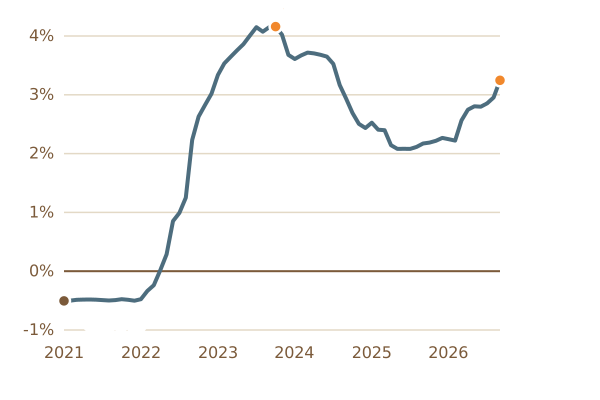
Using the ECB's monthly averages, the 12-month Euribor was minus 0.50 percent in January 2021. It then rose steeply through 2022 and 2023 to a peak of 4.16 percent in October 2023, came back to just over 2 percent in 2025, and was 3.25 percent in September 2026. A swing like this is why it helps to see what your payment would be if rates moved. Our article on mortgage payment examples shows the effect with simple numbers.
What to ask your bank#
- Which Euribor maturity does the loan follow, and how often does the rate reset?
- What margin does the bank add, and does it depend on conditions such as insurance or a salary account?
- Is a fixed rate available, and for how long?
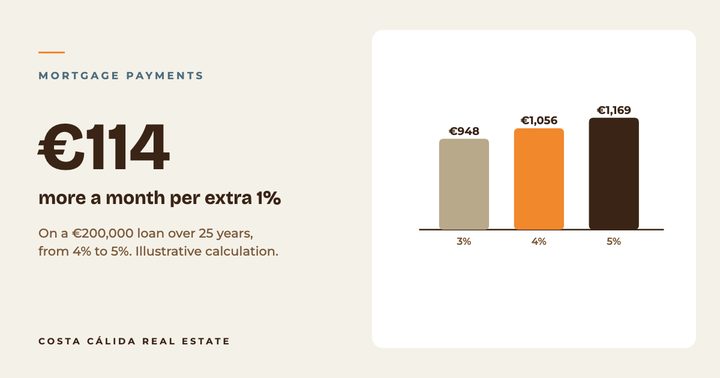
- What would my monthly payment be if the rate rose by one or two percentage points?
Details differ from bank to bank, so check them in the offer and in the contract. A gestor or lawyer can explain the contract before you sign.
You can try different rates yourself with our mortgage calculator, or talk to us about your plans.
Sources and further reading
Facts checked: 20 October 2026
Costa Cálida Insider
Get our monthly Murcia market report
Real figures on prices, mortgage rates and buying costs, plus a few homes we have looked at properly. Free, about once a month. Sign up and read our free buying guide straight away.
Thinking of buying on the Costa Cálida?
Talk to us about your plans. We guide you in Dutch or English, from the first call to the keys.
This article is general information and not legal, tax or financial advice. Rules change, so check your own situation with a qualified adviser. Read our full disclaimer.